What is LinkedIn lead generation?
LinkedIn lead generation is finding and qualifying the specific people who could buy from you — before any outreach happens. It is the list-building half of the funnel, and it determines more of your results than anything downstream: message quality, sequences and tooling all multiply the list, and multiplying a bad list produces more of nothing. Acceptance and reply rates are mostly decided the moment a lead enters your pipeline.
Start with an ICP worth writing down
An ideal customer profile is only useful if it is concrete enough to reject people. "B2B founders" rejects nobody. A working ICP names role, company size, industry, geography — and, most importantly, the signals that suggest the problem is live right now. Every lead source below gets filtered through this document, and every lead should be checkable against it: fit, or no fit, with a reason.
Where good leads come from
1. Search, done narrowly
LinkedIn search (and Sales Navigator, if you have it) is the obvious source and the most misused one. Broad filters produce huge lists of low-fit strangers — which then produce low acceptance rates, which is a safety problem, not just a conversion problem. Search narrow: exact roles, exact segments, one geography at a time, and cap list size at what you can actually research and contact well.
2. Buying signals
The difference between a directory and a lead list is timing. Watch for: a new executive in the buying seat (new leaders change tools), funding announcements, expansion into new markets, and public posts about the exact problem you solve. A medium-fit lead with a live signal usually beats a perfect-fit lead with no reason to care this quarter.
3. Engagement — yours and others'
People who react to or comment on relevant content have raised their hands in public. Three pools, in order of warmth: engagers on your own posts (they already know you), engagers on your competitors' and adjacent creators' posts, and active commenters in your niche. Posting consistently turns this from a tactic into a renewable lead source — which is why content belongs inside a lead-gen system, not next to it.
4. The people already in your orbit
Profile viewers, event attendees, existing connections whose role changed since you connected. These are the cheapest warm leads you have, and most pipelines ignore them completely.
Qualify before you contact
Every contact spends two scarce budgets: your account's LinkedIn limits and your credibility with the market. So qualification comes before outreach, not after. For each lead: does it match the ICP (with a stated reason), is there a signal (why now), and does research turn up an actual opening for a first message? Leads that fail stay on the list unscored or get dropped — they do not get "might as well" invites. The outreach guide picks up from here: warm-up, first messages and follow-ups for the leads that pass.
What qualification looks like in practice
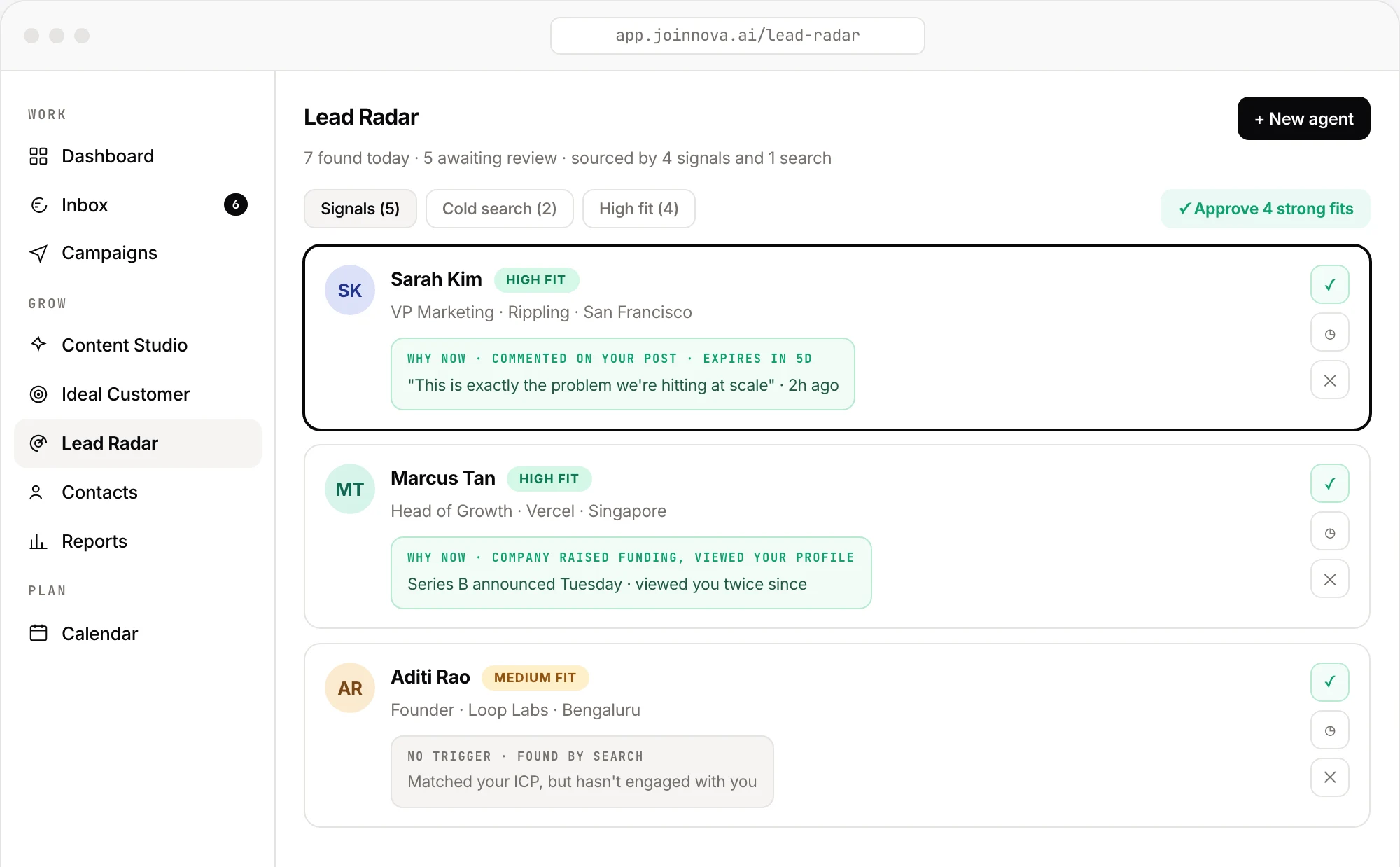
Concretely, a qualified lead record answers three questions in writing: fit (which ICP criteria it matches, which it fails), timing (the signal that says why this quarter — a hire, a launch, a post), and opening (the specific thing a first message could reference). This is what that looks like as a working queue — discovered leads scored against an ICP, waiting for a human decision:
A worked example: scoring one lead
Say your written ICP is "heads of sales or founders at B2B companies, 10–50 people, selling into mid-market, English-speaking markets" — with rejection criteria of "no agencies reselling services, no enterprise, nobody who joined the role under a month ago." A discovered lead: VP Sales at a 30-person B2B data platform, posted last week about their SDR ramp problem, company announced a Series A two months ago.
Scored honestly: fit — role matches, size matches, B2B motion matches; no rejection criterion triggers. Timing — two live signals, the funding (budget exists) and the public post (the problem is admitted). Opening — the SDR-ramp post is a first message that writes itself, because they raised the topic. This lead is a contact: every column has an answer you could defend out loud.
Now the same company, but the lead is a marketing manager who joined three weeks ago: role fails, tenure triggers a rejection criterion — no contact, however good the company looks. That discipline is the entire system. A lead list where every entry could survive this paragraph-long interrogation converts; a list padded with "close enough" entries spends your account's limits teaching LinkedIn your invites get ignored.
Automating discovery without automating judgement
Full disclosure: we build Nova, and this section explains our approach as much as it recommends one. Discovery is the part of lead generation software genuinely should do: watching search surfaces and signals daily, scoring what it finds against your written ICP, and showing its reasoning. Nova's Lead Radar does exactly that — and every discovered lead lands in a review queue, attached to no campaign, until a human approves it. Nothing is contacted because an algorithm liked it.
That boundary — automate the finding, keep judgement human — is worth demanding from any tool (how the popular ones compare), because a discovery pipeline wired straight into a sending pipeline is how thousands of perfectly good prospects get burned by software on your behalf.
The metrics that matter
- ICP-fit rate of new leads — what share of discovered leads survive qualification. Below ~half, your sources or your ICP need fixing.
- Signal coverage — how many contacted leads had a stated "why now."
- Acceptance and reply rates downstream — the delayed verdict on list quality.
- Meetings per hundred leads sourced — the end-to-end number that keeps every stage honest.
Where to start
Write the ICP down with rejection criteria. Pick two lead sources — one search, one signal- or engagement-based — and run them narrow for a month. Qualify everything before anyone is contacted, and judge the system on meetings per lead sourced, not on list size.
Frequently asked questions
Where do B2B leads actually come from on LinkedIn?
Four places, in rising order of warmth: search (LinkedIn or Sales Navigator filters matched to your ICP), buying signals (new executives, fresh funding, public posts about your problem), engagement (people reacting to your content, your competitors' content, or active voices in your niche), and your existing orbit (profile viewers, event attendees, connections whose role changed). Most teams over-rely on the first and ignore the last two — which is backwards, because engagement-sourced and orbit-sourced leads already know your name, accept invites at higher rates, and reply warmer. A durable pipeline draws from all four, filtered through one written ICP. Weight your effort toward warmth: ten engaged commenters in your niche usually out-convert a hundred cold search results, and they cost the account far fewer of its scarce, limited daily actions.
Do I need Sales Navigator for LinkedIn lead generation?
It helps, but it is not the deciding factor. Sales Navigator buys you sharper filters (seniority, company headcount, tenure, technology signals), larger search result pools, and lead lists — genuinely useful once your ICP is precise enough to exploit them. But the failure mode of LinkedIn lead generation is almost never "the filters were not granular enough"; it is contacting people who were never going to buy. A written ICP with rejection criteria, applied to basic search results, outperforms Sales Navigator applied to a vague one. Start with the free tier, prove your ICP converts on small narrow lists, and upgrade when filter precision — not lead volume — becomes your actual bottleneck. If you do upgrade, keep the discipline: sharper filters make it easier to build big mediocre lists faster, which is the exact failure they were supposed to fix.
What is a good ICP-fit rate for discovered leads?
If fewer than about half the leads your sourcing produces survive a check against your written ICP, fix the source or the ICP before contacting anyone. A low fit rate is a leading indicator that compounds downstream: weak lists produce low invite-acceptance, low acceptance damages account trust with LinkedIn, and damaged trust shrinks the volume you can safely send — so bad targeting eventually costs you reach as well as replies. The fit rate is also a test of the ICP itself: if you cannot decide whether a lead fits, the ICP is not written concretely enough to reject anyone, which is its actual job. Track the rate weekly rather than per batch — a slow drift downward usually means a source has quietly degraded or your market has shifted, and both are far cheaper to fix early.
Want discovery, scoring and research running daily with you as the final gate? Start free trial — self-serve, 7-day free trial, no card required.